D'Artagnan's encounter with the Man in Meung
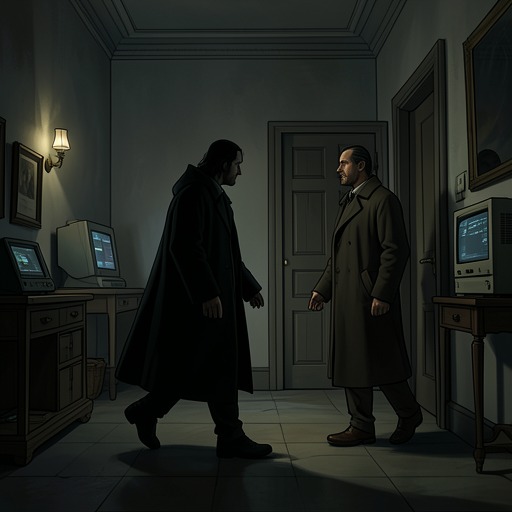
The Three MusketeersD'Artagnan's encounter with the Man in Meung is the novel's opening collision between youthful honor and the hidden machinery of power. At the Jolly Miller in Meung, a stranger's amusement at his horse provokes D'Artagnan into a fight that leaves him injured, deprived of his letter of introduction to M. de Treville, and convinced that the stranger has become his first great enemy. The encounter turns an aspiring recruit's journey to Paris into a personal quest for recognition and redress.
Setting and Initial Provocation
D'Artagnan arrives from Tarbes with the habits of a young man who interprets every smile as an insult and every glance as a challenge. His equipment and appearance invite ridicule: he rides a yellow horse, carries a sword of respectable length, and travels with a vade mecum that makes him resemble Don Quixote in his readiness to convert ordinary signs into threats. Until Meung, his anger remains largely potential; passers-by suppress their laughter because his sword and ferocious eye make mockery risky.
The restraint ends at the Jolly Miller. While dismounting, D'Artagnan sees through an open ground-floor window a well-made, stern-looking gentleman speaking with two respectful listeners. The gentleman is not discussing D'Artagnan himself but is enumerating the qualities of his horse, and the listeners repeatedly burst into laughter. To D'Artagnan, however, the distinction is immaterial. A half-smile is enough to awaken his irascibility, and the stranger's vociferous amusement becomes an insult demanding an immediate answer.
The stranger's appearance intensifies the impression that this is no ordinary passer-by. D'Artagnan observes a man between forty and forty-five, with black piercing eyes, a pale complexion, a strongly marked nose, and a black, well-shaped mustache. His violet doublet and hose are new but creased like traveling clothes long packed in a portmanteau. The young observer registers these details with unusual speed, instinctively sensing that the stranger will exert a powerful influence over his future. The scene therefore functions both as an accidental quarrel and as the first meeting with a concealed force in the larger plot.
The Fight at the Jolly Miller
D'Artagnan follows the stranger after the man attempts to leave and draws his sword, warning him to turn rather than be struck from behind. The stranger replies with astonishment and contempt, calling the young man mad. He also remarks that such a quarrelsome fellow might be useful to the king, who is seeking brave recruits for the Musketeers. The observation briefly exposes the institutional world toward which D'Artagnan is traveling, but it does not soften the insult or prevent escalation.
When the stranger finishes speaking, D'Artagnan makes a furious lunge. The man springs backward, recognizes that the matter has gone beyond raillery, draws his own sword, salutes his opponent, and takes a serious guard position. The duel is then interrupted before it can properly begin. The stranger's two listeners and the host attack D'Artagnan with sticks, shovels, and tongs. As D'Artagnan turns to face the shower of blows, his adversary sheathes his sword with precision and watches the melee with apparent impassiveness.
The interruption reveals the unequal social conditions surrounding the quarrel. D'Artagnan possesses courage and a sword, but the stranger has the authority to make others act for him. Even while D'Artagnan refuses to retreat and cries that he will kill the supposed coward, the stranger dismisses his resistance as another Gasconade and orders that he be returned to his orange horse and sent away. The encounter thus shifts from a prospective duel between individuals to a public humiliation in which numbers, local authority, and concealed rank overwhelm the young man's martial ideal.
The Lost Letter and the Hidden Stakes
The injured D'Artagnan is carried to a room, where the host explains that the stranger may be a great lord. During the incident, D'Artagnan had struck his pocket and declared that M. de Treville would judge the insult offered to his protege. The stranger immediately becomes attentive when he hears the name of M. de Treville, captain of the Musketeers, and asks what the pocket contains. The host confirms that it holds a letter addressed to M. de Treville.
This detail changes the meaning of the encounter. The stranger was not merely amused by D'Artagnan's horse or irritated by the young man's challenge; he has a specific interest in the letter that could introduce D'Artagnan to the Musketeers. He orders the host to keep D'Artagnan from being seen by Milady the English spy, who is expected to pass soon, and says that he should go on horseback to meet her. Before leaving, he turns toward the kitchen, where D'Artagnan's doublet is located, plainly intending to discover the contents of the pocket.
When D'Artagnan regains consciousness, the host urges him to depart quickly, warning that the police may punish him for quarrelling with a great lord. In the kitchen, D'Artagnan sees his antagonist speaking calmly beside a heavy carriage drawn by two large Norman horses. He overhears the stranger's companion ask why he is returning to Paris without chastising the insolent boy. D'Artagnan then rushes through the doorway and declares that the man he ought to chastise will not escape him again. The personal challenge resumes precisely as the stranger's political significance begins to emerge.
Consequences and Arrival in Paris
The host tells D'Artagnan that the stranger became disturbed when he learned of the letter and went directly to the kitchen, where he knew D'Artagnan's doublet had been placed. D'Artagnan therefore identifies him as the thief and resolves to complain to M. de Treville, who, he believes, will complain to the king. His conclusion is partly mistaken in its certainty, but it gives the incident its immediate forward force: the lost letter becomes a grievance, and the grievance becomes D'Artagnan's first appeal to royal and military authority.
D'Artagnan pays the host two crowns and leaves Meung on the yellow horse. At the gate of St. Antoine in Paris, he sells the animal for three crowns, a generous price explained by the originality of its color despite the hard final stage. He enters Paris on foot with his small packet under his arm and rents a garret in the Rue des Fossoyeurs near the Luxembourg, a lodging suited to his scant means. The adventure has stripped him of the horse that marked his provincial arrival, but it has also carried him to the city where his ambition may acquire an institutional form.
His first day in Paris converts injury into preparation. He sews ornamental braid onto his doublet and hose using material secretly taken by his mother from an almost-new doublet belonging to the elder M. d'Artagnan. He then goes to the Quai de Feraille to have a new blade fitted to his sword. Finally, he asks a Musketeer for the location of M. de Treville's hotel and learns that it is in the Rue du Vieux-Colombier, immediately near his own chamber. The proximity appears to him a happy augury, yet the reader knows that his road to M. de Treville has already been obstructed by the stranger who sought his letter.
Narrative Significance
The encounter establishes a recurring pattern in D'Artagnan's story: a seemingly minor affront opens into a network of political danger, and impulsive bravery becomes the means by which he enters that network. His susceptibility is comic because he mistakes laughter at a horse for an attack on his dignity, but it is also productive. The same instinct that creates the quarrel drives him to pursue the stranger, defend himself against several assailants, protect his claim to honor, and continue toward Paris after losing his letter.
The scene is also a threshold ordeal. D'Artagnan leaves the familiar world of Tarbes and reaches Meung, where his first test does not reward formal skill or fair combat. His swordsmanship is interrupted by improvised weapons; his letter of introduction disappears; and the adversary escapes behind a carriage, a network of attendants, and the authority suggested by the host's fear. The value at stake shifts from simple dignity to access: D'Artagnan must now win entry to the world represented by M. de Treville without the document that was meant to secure it.
Most importantly, the stranger remains unidentified within the immediate episode while becoming unmistakable as a future danger. D'Artagnan sees only a stern gentleman in violet traveling clothes, yet the man already knows the importance of M. de Treville, takes an interest in Milady the English spy, and seeks the contents of the letter. The encounter's irony lies in D'Artagnan's inability to understand the scale of what has happened. He thinks he has found a thief and an insolent joker; in fact, he has crossed paths with the concealed political opposition that will shape his advancement, his friendships, and his continuing pursuit of honor.